Copper Concentrate: Grade, Penalties and Plant Targets
A copper concentrate specification is a plant design document in disguise.
Discuss your project
Overview
What copper concentrate is
Copper concentrate is the intermediate product of froth flotation on a copper sulfide ore. It contains copper sulfides such as chalcopyrite or bornite, iron sulfides, and a mix of minor minerals that report to the froth. The concentrate is not a refined metal; it's a traded material that a smelter buys and then processes through roasting, smelting, converting and electrorefining. The grade of a copper concentrate is the percentage of copper by mass, typically reported on a dry basis, and it's the first number a buyer checks. But grade is not the only number that matters.
You'll see concentrate described by its Cu content, its moisture, and a list of penalty elements. Because smelting charges are often based on the contained copper after deductions, the plant's product specification is effectively a commercial contract written as a process target. That means every unit operation in the concentrator exists to meet a saleable concentrate specification, not to make a laboratory-grade mineral.
What smelters actually buy
Smelters buy a material they can charge into a furnace, not a theoretical concentrate. Their contracts define a minimum payable copper content, a set of allowable impurity levels, and a moisture limit. The exact figures are commercial and vary by smelter, orebody, and environmental regulation, so no single universal grade range exists. What matters is that the smelter terms propagate backwards into plant design. If a smelter will reject or penalise concentrate above a certain arsenic level, the flowsheet must remove arsenic before shipping. If moisture must be below a transportable limit, the dewatering circuit becomes a contractual requirement.
For background on copper supply and demand that frames these negotiations, see the USGS Copper Statistics and Information. When testwork and feasibility studies feed public reporting, the JORC Code sets the standard for how resources and reserves are disclosed.
Why plants optimise grade-recovery, not grade alone
The grade-recovery trade-off is the central economic curve in a copper concentrator. Maximising concentrate grade alone is rarely the right target, because every percentage point of extra grade usually costs recovery. Rejecting copper to tailings to chase a high-grade concentrate reduces payable metal and can destroy project value. The plant's job is to find the point on the curve that maximises revenue after smelter charges, freight, and downstream costs. That point is not fixed; it depends on ore mineralogy, liberation size, and the smelter terms.
Testwork defines this curve. In one Xinhai test programme for a copper flotation project, a grind of 50% passing 200 mesh produced a concentrate grading 16.23% Cu with 66.23% recovery. That result is not a universal answer—it's a single data point from a specific ore and reagent regime. A different ore would give a different curve. You'll need locked-cycle tests and variability sampling to turn a flowsheet into a robust plant.
Impurity penalties and how they shape the circuit
Arsenic, fluorine, and moisture are three common penalty parameters, but smelter terms can also include bismuth, mercury, antimony, lead, and zinc. Penalties are deductions applied per tonne of concentrate when an impurity exceeds an agreed threshold. High arsenic, for example, can complicate off-gas treatment and reduce the value of the sulphuric acid by-product. High fluorine attacks furnace linings and pollutes acid plants. High moisture adds freight cost, creates handling problems, and can cause freezing or spontaneous heating in a ship's hold.
These penalties are not abstract. They drive circuit decisions. If the ore contains arsenic-bearing minerals like enargite or tennantite, you'll need selective flotation, controlled oxidation, or blending to keep arsenic below contract limits. Fluorine often reports from fluorine-bearing gangue, and its control may require reagent changes, pH control, or physical separation ahead of flotation. Moisture is managed in thickening and filtration, and the target is set by the concentrate specification, not just by what the filter can achieve on a good day.
Flotation circuit design and regrind consequences
A concentrate specification is a design input, not an afterthought. The flowsheet must produce a concentrate that meets grade and impurity limits at an acceptable recovery. This usually means multiple stages: rougher flotation to recover as much copper as possible, then cleaning stages to reject gangue and raise grade. Each cleaner stage increases grade but loses some copper to the cleaner tailings, which are often recirculated. Froth flotation is the core separation step, and the circuit arrangement—roughing, scavenging, cleaning—directly determines the shape of the grade-recovery curve.
Regrind is often the lever that unlocks a higher grade without collapsing recovery. A rougher concentrate may be too coarse to separate cleanly in cleaner flotation, so it's reground before cleaning. The regrind product size determines liberation of the copper minerals from pyrite and gangue. Finer grinding improves liberation but increases energy consumption and slimes generation, and it can depress flotation kinetics. The optimum regrind size is a testwork question, not a rule of thumb. You'll need metallurgical testwork to quantify how regrind changes grade and recovery together.
Dewatering and the final product spec
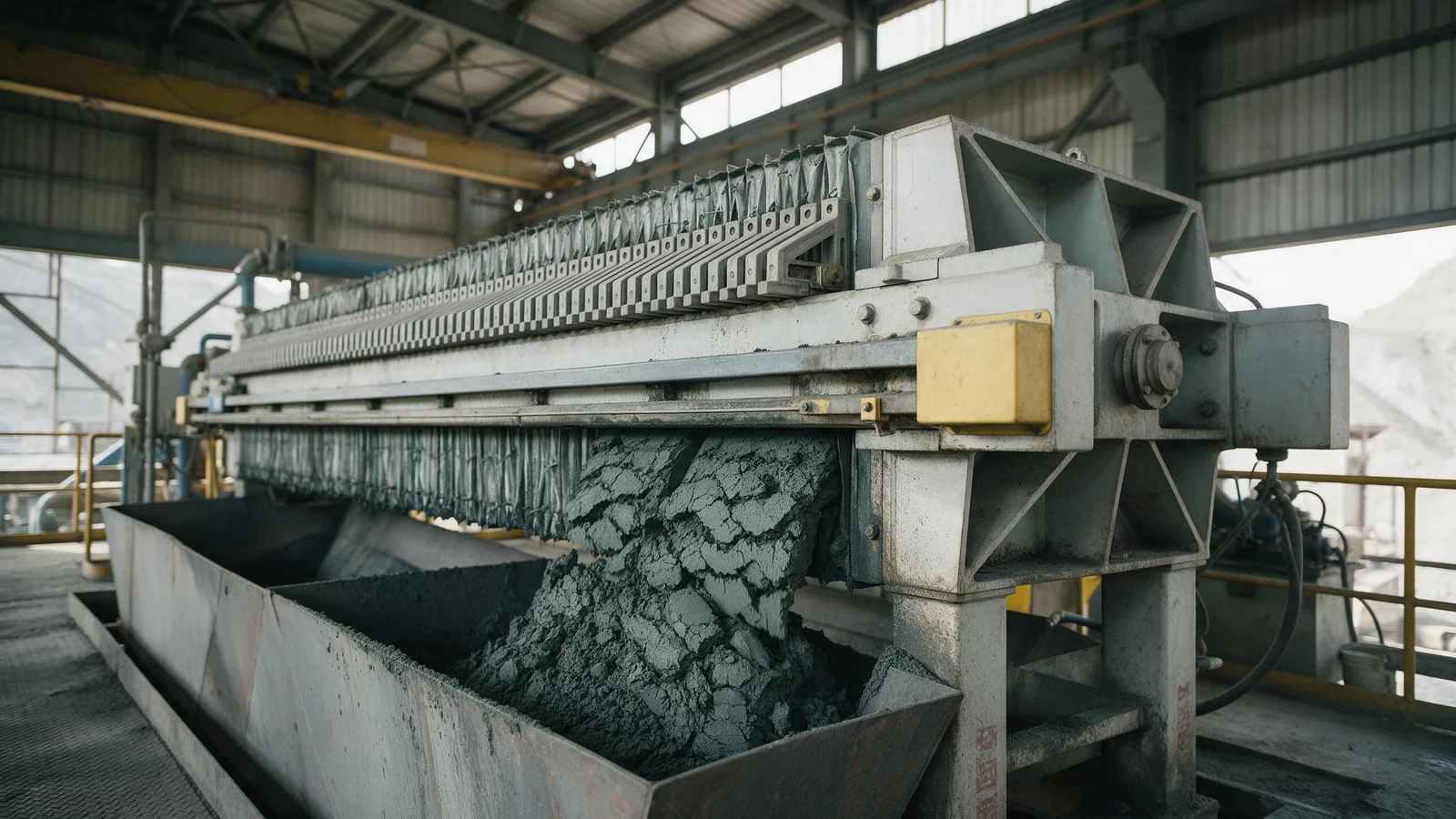
Concentrate moisture is a commercial term, not just a process outcome. Shipping a wet concentrate costs more in freight, risks cargo liquefaction, and can generate dust when too dry. Most smelter contracts specify a maximum moisture limit, often around 8% or 10%, but the exact number is contractual and varies with transport mode and climate. The dewatering circuit therefore includes thickening to recover process water and filtration to reduce moisture to the target. Mineral processing flowsheet design must integrate dewatering from the start, because the concentrate thickener and filter are sized from the planned concentrate tonnage and the target moisture.
Filter selection depends on the concentrate's settling and filtration behaviour. Ceramic disc filters can produce low moisture, but they're sensitive to particle size and blinding. Pressure filters can achieve lower moisture but cost more in capital and operating expenditure. The right choice comes from filtration testwork and a clear target from the smelter terms. Don't treat dewatering as an add-on; it's part of the specification.
How Xinhai turns a spec into a plant
Xinhai's approach starts with testwork and flowsheet development, then moves through engineering, procurement, construction, and operation. According to the company's published figures, Xinhai reports more than 600 EPC+M+O projects and 2,500+ mines served, but the engineering logic is specific: the concentrate specification is translated into equipment selection, circuit configuration, and operating targets. Xinhai's equipment range includes flotation cells up to 320 m³ and thickeners to 100 m diameter, but the selection always follows the testwork and the commercial terms.
The design process typically moves through a sequence that ties directly back to the concentrate specification:
- Mineralogical characterisation identifies copper minerals and penalty elements.
- Batch flotation tests map grade-recovery response to grind and reagent conditions.
- Locked-cycle tests validate cleaner circuit configuration and circulating loads.
- Pilot plant runs confirm scale-up and produce representative concentrate for smelter evaluation.
If the smelter demands a tighter arsenic limit, the test programme includes arsenic rejection testwork. If the moisture limit is strict, filtration testwork becomes a gating item. The result is a plant that delivers a saleable product, not just a high-grade one.
Frequently asked questions
What is copper concentrate grade?
It is the percentage of copper by mass in the concentrate, measured on a dry basis. Smelters set payable and penalty terms around this figure.
Why don't plants just maximise concentrate grade?
Because higher grade usually means lower recovery, and the lost copper to tailings can outweigh the higher smelter payment. The optimum is the point that maximises revenue after deductions.
Which impurities carry penalties in copper concentrate?
Arsenic, fluorine, moisture, bismuth, mercury, antimony, lead, and zinc can all be penalised depending on the smelter contract. Arsenic and fluorine are particularly common.
How does the concentrate specification affect plant design?
It sets targets for flotation cleaning stages, regrind size, impurity rejection, and final moisture, so the flowsheet is built backwards from the smelter terms.