Metallurgical testwork: what each stage actually decides
Every recovery number in a plant design traces back to a bench somewhere. Here is the stage chain — from chemical analysis to semi-industrial pilot plant — the design question each stage closes, and why the sample decides more than the laboratory does.
Discuss your project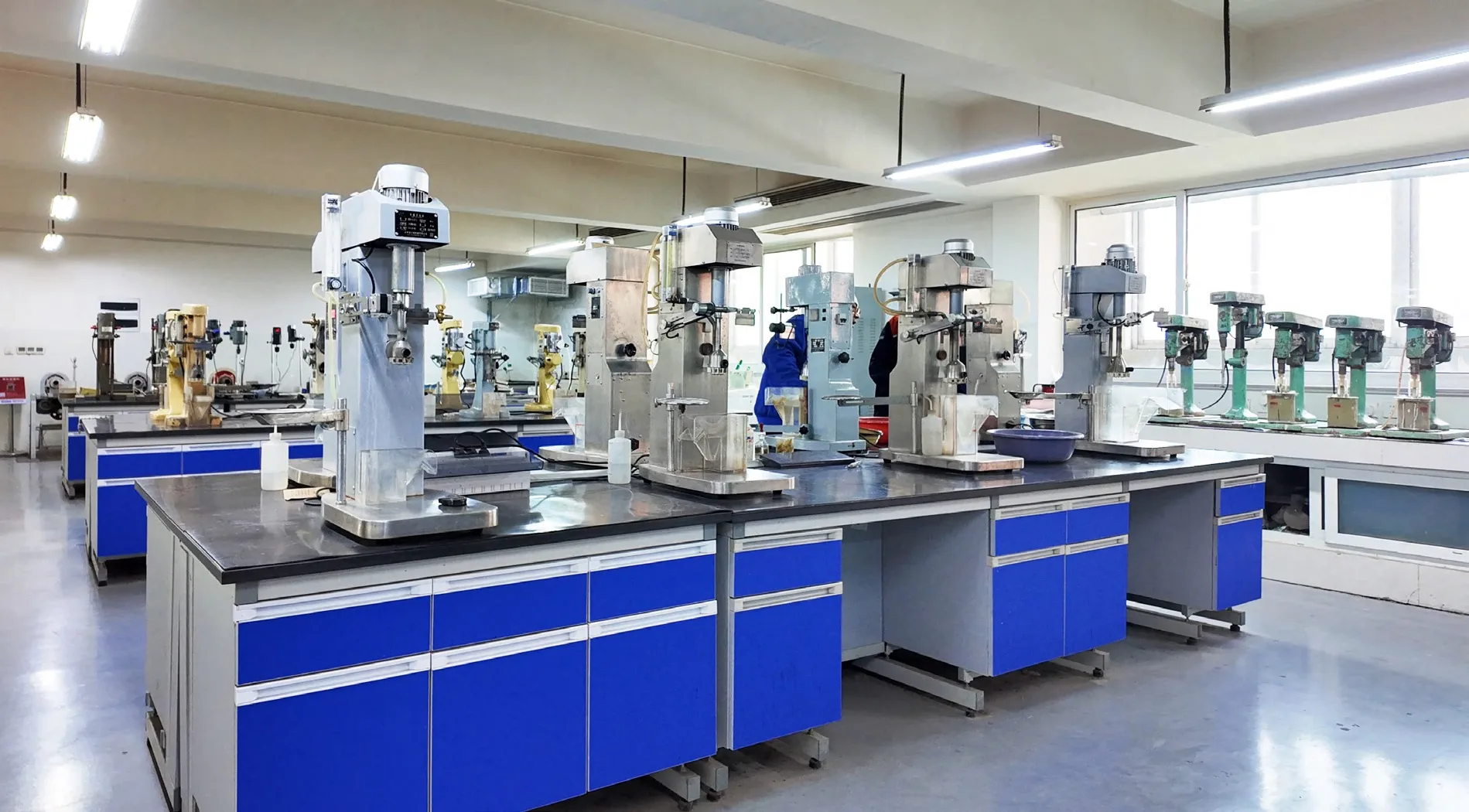
Overview
Metallurgical testwork is where a mining project stops guessing. Before anyone sizes a mill, commits to a reagent scheme or signs off a flowsheet, somebody has to demonstrate on the actual ore how its minerals behave. That demonstration runs through a defined chain of stages — chemical and mineralogical analysis, exploratory bench tests, condition tests, open- and closed-circuit tests and, where the scale-up risk justifies it, a semi-industrial pilot plant. Each stage exists to close out one design question. Skip a stage, and the question doesn't disappear. It gets answered later, on site, at full capital cost.
You'll see the same work called ore testing, mineral processing testwork or metallurgical testing. A caution on that last name: in search results and supplier directories, metallurgical testing usually points at materials laboratories that certify welds, alloys and fasteners. That's a different industry. This page is about ore — the programmes that decide how a deposit becomes a process plant.
Why testwork carries the weight it does
Reserve reporting standards treat testwork as first-order evidence. The JORC Code, 2012 Edition, asks reporters to address "the nature, amount and representativeness of metallurgical test work undertaken" on an if-not-why-not basis when ore reserves are reported, and it asks specifically whether bulk-sample or pilot-scale work exists and how well those samples represent the orebody as a whole. Comparable reporting codes ask the same questions in their own words. Lenders read those sections closely before they price a project's risk.
The commercial logic is blunt. A recovery assumption without test support is an opinion, and plants get financed, sized and staffed on those assumptions. Testwork is cheap relative to a flotation circuit that turns out to need one more cleaning stage than the design allowed for. It's the difference between learning that on a bench charge and learning it in concrete and steel.
The stage chain, and what each stage answers
A full programme moves from grams to tonnes in deliberate steps. Here's the sequence, with the question each stage is there to settle.
- Chemical and mineralogical analysis. Element assays, spectral analysis and phase analysis establish what the ore actually contains: which minerals host the value, roughly where they liberate, and which impurities will follow the concentrate if nobody stops them. What it settles: the minerals you're separating and the penalties you're fighting.
- Exploratory tests. Quick bench passes across candidate routes — flotation, magnetic separation, gravity, leaching — to see which family of processes the ore responds to. What it settles: which route deserves the rest of the programme's budget.
- Condition tests. One variable at a time on the chosen route: grind fineness, pulp density, pH, reagent types and dosages. What it settles: the operating point where the route performs.
- Open-circuit tests. Products move forward only, so the contribution of each roughing, scavenging and cleaning stage shows up plainly. What it settles: how many stages the circuit needs.
- Closed-circuit tests. Middlings now recirculate, the way they will in the plant, and grade and recovery settle toward values a designer can commit to. What it settles: the numbers the design basis can carry.
- Semi-industrial continuous tests. The pilot plant runs the flowsheet as a connected circuit over an extended period, on far larger charges than the bench. What it settles: whether the process holds up in continuous operation, and what that means for scale-up and equipment selection.
A bench test tells you the chemistry works. A pilot plant tells you the circuit works. They aren't interchangeable, and whether you need the second depends on how novel the route is and how much variability the deposit carries. A clean, well-understood magnetite might close its open questions at bench scale, while a polymetallic ore with a stubborn middlings problem usually can't — the recirculating load behaves differently in continuous operation than any batch test can show, and that's precisely the behaviour a designer needs to see before committing to equipment sizes.
The output of the chain isn't a report for the shelf — it's the direct input to flowsheet development, where recorded grades, recoveries and stage counts get turned into a connected plant design.
Sample representativeness decides the result before the lab does
No laboratory can make an unrepresentative sample representative. Every stage above assumes the material on the bench behaves like the orebody it came from, and that assumption fails more often than any instrument does. Oxidized material near surface responds differently from fresh rock at depth. Grade varies by zone. Clay content varies bench to bench. A composite that quietly over-weights the easy ore will produce a lovely recovery curve the plant never sees again.
So before you ship anything, write three things down. First, where the sample came from — which holes, which depths, which zones — and how the intervals were combined. Second, whether it represents the material the plant will treat in its early years or just the average of the whole resource; those can be very different feeds. Third, who handled it between the rig and the courier, and how it was stored, because sulphide surfaces oxidize and flotation response drifts with them. None of this is exotic. It's chain-of-custody discipline, and it costs almost nothing compared with what it protects.
Three programmes from the archive, numbers as recorded
These are test outcomes from our engineering archive, as recorded in our project brochures. They're laboratory and pilot results — evidence of what a specific ore did under stated conditions, never a promise of production performance on a different ore.
Copper flotation for a 1.5 Mt/a plant in Kazakhstan
Closed-circuit testing ran at a grind of 50 percent passing 200 mesh, with one roughing, two scavenging and three cleaning stages. The recorded result: a copper concentrate at 3.50 percent yield, 16.23 percent Cu and 66.23 percent recovery. Three cleaning stages reads as a small detail in a finished flowsheet; as a matter of method, stage counts like that are settled in open-circuit testing before the closed-circuit run confirms them. The full write-up is on the Kazakhstan copper flotation test programme page.
An extended continuous phosphate test in Pakistan
The route that survived this programme: direct flotation with two roughing, two scavenging and two cleaning stages, then acid conditioning, then three stages of reverse flotation. Recorded concentrate: 62.10 percent yield, 22.43 percent P2O5 grade and 56.10 percent recovery. A sequence like that doesn't come out of a handbook. It comes from running the stages in sequence on the actual ore.
Heavy media separation for a Zimbabwe lithium ore
On a 2 Mt/a spodumene project, the petalite in the ore resisted clean separation by flotation. The programme shifted to heavy media separation instead: heavy-liquid tests with tetrabromoethane at laboratory scale, then pilot verification using ferrosilicon media. The recommended flowsheet ran crushing and screening, HMS to recover petalite, grinding and classification, gravity separation for tantalum and niobium minerals, desliming, mica flotation and finally spodumene flotation. Petalite is itself a lithium ore mineral, so a route that recovered it rather than losing it to tailings mattered enough to justify the extra test stages. For context, the USGS Mineral Commodity Summaries 2026 counts five mineral operations in Zimbabwe among the operations that together accounted for the majority of world lithium production.
Where Xinhai fits, and what to send
Xinhai runs this chain through a CNAS-accredited laboratory operating to ISO/IEC 17025, with an industrial-scale pilot test base behind it. The company's research brochure records approximately 200 test studies a year, and Xinhai reports experience across more than 70 ore types — the case numbers above come out of that same archive. Test capability spans gravity, magnetic and flotation separation, cyanide leaching and adsorption, bio-oxidation, acid leaching and hydrometallurgy, heap leaching, and tailings thickening and dry stacking, plus grindability characterization to support mill selection.
The part that's easy to miss: the people who run your tests sit in the same group as the people who design the plant and the people who commission it. That continuity is the practical argument for testwork inside an EPC+M+O scope — a test programme produces decisions somebody downstream has to live with, and here that somebody is in the next office. It also shortens the argument later, when commissioning results need reconciling against the design basis.
If you're weighing a programme now, send the mineral, the country, the expected capacity, the project stage and whatever assays or reports already exist — plus an honest note on how your sample was taken. If the sample can't support the decisions you need, we'd rather say so before the programme starts than after it ends. Talk to the test team.