Placer mining: what the river built, and what gravity gives back
Placer deposits put more gold into human hands than any other deposit type, and they still get mined with the simplest tool in mineral processing: density. This guide walks through how placers form, why they're hard to sample, and why your recovery ceiling is set by gold particle size rather than by equipment brand.
Discuss your project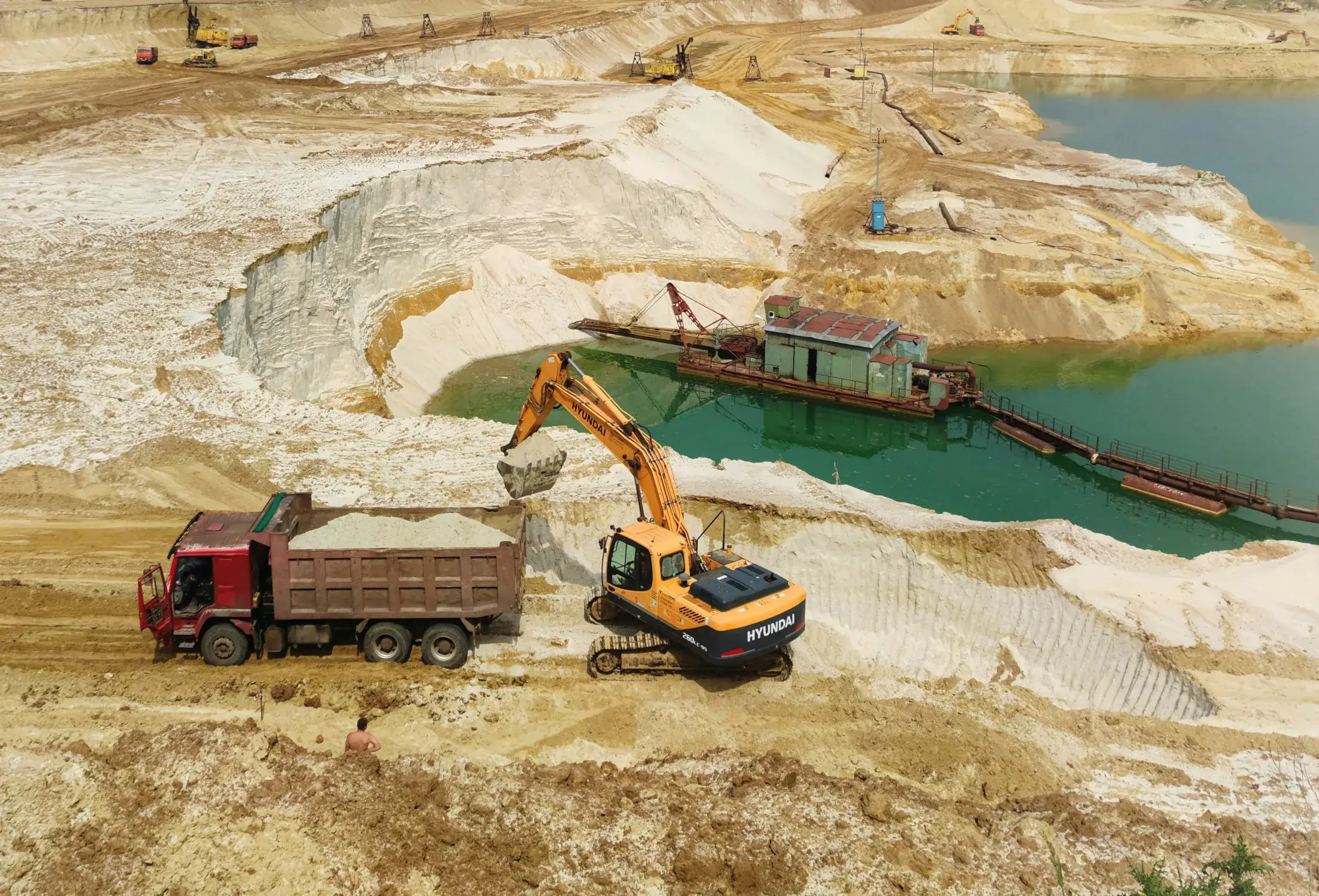
Overview
Placer mining is the recovery of a valuable heavy mineral — most often gold — from sand and gravel rather than from solid rock. No blasting, usually no chemicals, and a flowsheet that a miner from a century ago would still recognise. The US Geological Survey defines a placer as a deposit of sand, gravel and other detrital material in which a valuable mineral has accumulated through weathering and mechanical concentration, and it credits placers with more than two-thirds of the total world gold supply. That's a remarkable share for deposits you can often dig with an excavator.
This guide covers how placers form, what makes alluvial gold mining awkward to evaluate, how the deposits are worked on dry ground and under water, and how the placer gold recovery chain — sluice, jig, shaking table, centrifugal concentrator — actually behaves. It ends with the one idea that should shape every equipment decision: the deposit's gold size distribution sets your recovery ceiling before any machine arrives on site.
What a placer deposit is, and how it forms
The USGS describes placer formation in three stages. First, weathering: long exposure breaks down a gold-bearing lode or mineralised zone, and the gold — chemically and physically durable — survives while the host rock decomposes around it. Second, concentration: running water carries the liberated material downstream, and because pure gold has a specific gravity of 19.3, it works its way down through the moving gravel while lighter minerals wash on. Most of that sorting happens during floods, which may do a year's concentrating work in a single event. Third, preservation: unless something protects the deposit — burial under younger sediment or a lava cap, or uplift out of the river's reach — the same forces that built it will eventually tear it apart.
Two practical consequences follow. The richest gravel usually sits at or near bedrock, and gold works so far into bedrock cracks that operators commonly mine as much as a metre of the bedrock itself to get it all. The exception the USGS flags is "flood gold": very fine particles concentrated near surface. In practice, that means surface samples can mislead in both directions.
Why placer exploration humbles everyone
The USGS makes a blunt observation: each placer is unique. Regional erosion sets the broad location, but local conditions — channel shape, bedrock character, flood history — control the final form. Steeply dipping slates and heavily jointed rocks trap gold well; smooth unweathered granite makes a poor gold saver. Two gravel terraces a kilometre apart can behave like different deposits entirely.
Grade estimation is the harder problem. Placer gold is coarse, scarce and unevenly scattered, so a small drill sample either hits a particle and wildly overstates the grade, or misses and understates it. That's why serious placer evaluation leans on bulk sampling — pits, shafts, large-diameter drilling — and on washing real volumes of gravel, because spoonful-sized assays lie. And the sampling programme shouldn't stop at grade. You need the size distribution of the gold itself, the clay content, and the proportion of flat, flaky particles, because those numbers decide what your plant can recover. That's testwork, and it belongs before plant design, not after. We've written separately about how metallurgical testwork feeds engineering decisions; the logic applies to gravels just as much as to hard rock.
Two ways to mine: dry ground or floating plant
Land-based (dry) mining is the common modern arrangement for bench and terrace gravels. Excavators or loaders feed a mobile wash plant; a trommel or scrubber breaks up clay and screens out oversize; the undersize goes to gravity recovery. The plant moves as the pit advances, and water has to be brought to the gravel, stored, clarified and recycled. It's flexible, the capital threshold is low, and the mining cost per cubic metre is driven mainly by haul distance and clay.
Dredging inverts the arrangement: the plant floats on its own pond and the gravel comes to it. Bucket-line dredges dug the deep gravels of the California and Alaska goldfields, and the USGS records that dredge fields were reworked repeatedly as equipment improved and cut-off values changed. Modern suction and cutter-head dredges work shallower ground with far less steel. Dredging suits large, low-grade, water-saturated deposits where dry excavation would fight the water table on every shift. Hydraulic mining — washing whole banks through giant nozzles — built much of this history, but court action over downstream sediment damage ended large-scale hydraulicking in California, and it survives today only in heavily regulated forms.
The gravity recovery chain, stage by stage
Placer flowsheets are short. After scrubbing and screening, everything is gravity separation, usually arranged rougher-to-cleaner. The California Division of Mines and Geology's Special Publication 87 — a standard reference on placer gold recovery — puts working size ranges on each stage, and they're worth knowing.
- Sluices are the high-capacity workhorse: cheap, portable, nearly maintenance-free. Their weakness is fine gold. SP 87 is direct about it — a plain sluice doesn't recover fine gold effectively, which is why sluice-only operations leave metal behind.
- Jigs pulse water through a bed of ragging to stratify particles by density. SP 87 rates conventional jigs as effective from about 25 mm down to roughly 150 microns, with recovery of gold finer still reported.
- Shaking tables are cleaner-duty machines: low capacity, high precision. SP 87 credits them with efficient recovery of heavy minerals from about 150 mesh down to a few microns — provided the feed is closely classified first. Feed a table a wide size range and its efficiency falls apart.
- Centrifugal concentrators multiply gravity. A fluidised ribbed cone spinning at high speed traps heavy particles while backpressure water keeps the bed mobile. In test programmes reported by SP 87, this class of machine recovered gold down to roughly 38 microns — the flour gold a sluice was never going to hold.
A typical modern chain runs trommel to sluice or jig as the rougher, then a centrifugal unit on the fines, with a shaking table cleaning concentrates before smelting. The same machine families appear across our gravity separation equipment range — sawtooth-wave jigs, shaking tables, spiral chutes and centrifugal concentrators — and the broader logic of staged separation is covered in our guide to the ore dressing process.
Your recovery ceiling is set by particle size, not brand
Here's the number that should reframe the equipment conversation. According to SP 87, early placer miners recovered no more than about 60% of assayed gold values, and even well into the twentieth century, free-gold recovery averaged only 70–75%. The gold wasn't stolen. It was flat, fine, and hydraulically stubborn — a flake of flour gold has so much surface area for its weight that it behaves like a light mineral in moving water, and no riffle holds it.
SP 87 lists the variables that actually govern recovery: gold particle size, gold size distribution, clay content, mining method, and the character of the wash water. Read that list twice — equipment brand isn't on it. A well-run circuit built from ordinary machines, correctly matched to the measured size bands and fed properly scrubbed gravel, will consistently beat a premium machine fed clay balls and unclassified feed. What moves the ceiling is scrubbing that releases gold from clay, classification that sends each size band to the right device, a fines stage that can hold sub-100-micron particles, and disciplined cleanup routines. What doesn't move it is a logo.
Water, mercury, and the reclamation bill
Placer mining's environmental record is mixed, and it's worth being honest about why. Historic practice leaned on mercury in riffles to catch fine gold — SP 87 documents the method while warning that mercury escape into the environment must be prevented. A modern gravity-only circuit doesn't need mercury at all, which is one of the format's genuine advantages: density does the work, and what leaves the plant is washed sand and gravel.
The obligations that remain are hydraulic and physical. Wash water picks up fines, so settling ponds and recycle circuits keep turbidity out of the receiving stream. Worked-out ground gets recontoured, capped with saved topsoil and revegetated — and because placer pits advance quickly, reclamation can follow progressively behind the mining face instead of waiting for closure. Plan the water balance and the reclamation sequence at design stage and neither becomes a crisis later. Tailings from a placer operation are simpler than a hard-rock slurry impoundment, but the design discipline we describe for tailings storage facilities — characterise the material, control the water, plan the closure — applies in miniature.
Where testwork and engineering support fit
Our own published project record covers hard-rock and industrial-mineral plants rather than placer operations, so we won't pretend otherwise. What transfers directly is the discipline: sample properly, measure the gold size distribution before choosing machines, and let the testwork write the flowsheet instead of the catalogue. Xinhai manufactures the gravity equipment families this article describes, and its laboratory record includes gravity test programmes on zircon–titanium mineral sands — spiral chute roughing followed by magnetic and gravity–electrostatic separation, as recorded in our project brochures. If you're weighing a placer or alluvial project and want the test-first route, our engineering and testwork services are the place to start the conversation.