Plant Sampling: Where Metallurgical Accounting Fails
Every recovery number you report starts with a sample, and if that sample lies, your entire plant accounting lies with it.
Discuss your project
Overview
Plant sampling is where metallurgical accounting either stands or falls. You can run the tightest laboratory assays in the world, but if the sample arriving at that lab doesn't represent the stream it came from, every downstream number is fiction. Sampling error is the largest single source of bias in plant metallurgical accounting. It's not close. A recovery figure is only as good as the sample that generated it. So before you trust a mass balance, you need to understand what a representative sample actually is, where to collect it, and how a bad sample quietly corrupts your reported recovery.
Why Sampling Is the Weak Link in Metallurgical Accounting
Metallurgical accounting is the formal process of reconciling plant inputs and outputs to calculate recovery, mass pull, and inventory. It relies on measured grades and tonnages at feed, concentrate, and tailings streams. Those measurements depend entirely on samples. The USGS Mineral Commodity Summaries show that gold ores often contain only a few grams of metal per tonne. That means the analytical sample might be a few grams drawn from a stream moving hundreds of tonnes per hour. If those few grams are biased—even slightly—the resulting grade is not an estimate of the stream; it's an estimate of a completely different material. Sampling error, not assay precision, dominates the uncertainty in metallurgical accounting.
Representative Increments, Cutter Design, and Sample Mass
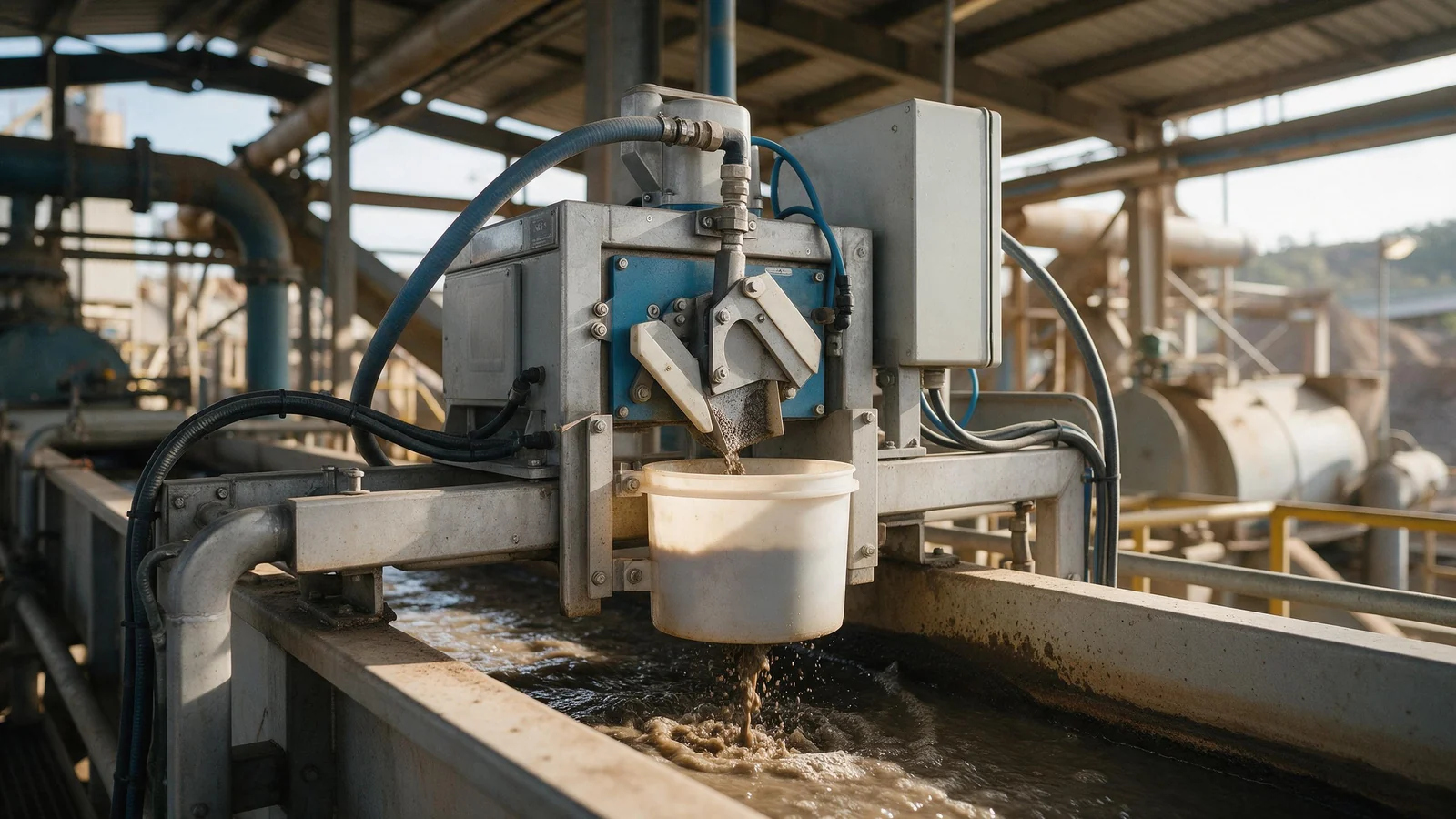
A representative increment is a portion of a process stream collected in such a way that every particle in the stream has the same probability of being selected. That sounds simple, but it's rarely achieved by hand. A cross-stream cutter is the standard tool: a narrow, rectangular opening that traverses the entire flowing stream at a constant speed, cutting the stream at right angles. The cutter must be wide enough to avoid bridging—typically at least three times the top particle size—and it must travel completely across the stream without splashing or overflowing. Cutter design matters because a poorly designed cutter selectively rejects coarse or dense particles, introducing systematic bias.
Sample mass is tied to particle size. The larger the top particle size, the larger the minimum sample mass needed to keep the fundamental sampling error low. The relationship is non-linear: as top size increases, required sample mass grows much faster. You can't just take a fixed scoop and expect it to represent a coarse stream. If the sample mass is too small for the particle size distribution, the sample cannot contain a statistically meaningful number of the largest particles, and the grade will swing wildly from increment to increment. This is why a few grams from a fine flotation concentrate can be adequate, while the same few grams from a coarse crusher product is almost meaningless.
Where Sample Points Belong in a Concentrator
You need sample points at every location where a mass balance node exists. The essential points are the feed stream, the final concentrate, and the final tailings. Additional points—such as mill discharge, cyclone overflow, and cleaner tailings—help isolate circuit inefficiencies. To build a defensible sampling scheme, follow these steps: first, map the process flow and identify all material balance inputs and outputs. Second, install automatic cross-stream cutters on continuous flows and belt samplers on conveyor belts. Third, collect increments at regular time intervals, using a timer that accounts for flow rate changes. Fourth, combine those increments into a shift or daily composite, weighting each increment by the tonnage it represents. Fifth, split the composite down to a laboratory sample using a rotary splitter or riffle splitter. A well-placed sample point gives you a stream's true grade; a poorly placed one gives you a number that only reflects the sampling device.
Automation systems like those described in mineral processing flowsheet development help enforce consistency. Timed cutters, flow-proportional samplers, and online particle size monitors reduce operator influence. But instrumentation alone doesn't fix a bad sample point. The location must be accessible, free of dead zones, and installed where the stream is fully mixed.
Grab Samples vs. Proper Composite Sampling
A grab sample is a single instantaneous portion taken by hand—a scoop from a launder, a handful from a belt, a bucket from a sump. It is easy and fast, and it is almost always wrong. The stream varies minute to minute in grade, particle size, and moisture. One grab cannot represent hours of production. A composite sample is a collection of increments taken over a defined period and combined proportionally to flow. The difference is not just quantity; it's representativeness. A composite built from regular, correctly designed increments averages out short-term fluctuations and approaches the true mean of the stream.
To build a proper composite, first decide the sampling period—a shift, a day, or a complete batch. Second, set the increment frequency based on stream variability and sample mass requirements. Third, collect each increment with a correctly designed cutter. Fourth, store increments in a sealed container, preventing moisture loss or contamination. Fifth, after the period ends, mix the increments thoroughly and split them down to the analytical sample. Skipping any step reintroduces bias. If you need a quick check, a grab sample is better than nothing, but you should never use it for metallurgical accounting. It simply doesn't carry the statistical weight.
What a Bad Sample Does to a Mass Balance and Reported Recovery
Recovery is calculated from feed, concentrate, and tailings grades and tonnages. If any of those samples is biased, the recovery number lies. Consider a tailings sample that systematically under-reports the metal grade—perhaps because the sampler missed the fine fraction where metal losses concentrate. The mass balance then thinks you recovered more metal than you did. Reported recovery rises, and you might celebrate a phantom improvement. Conversely, a biased feed sample that over-reports head grade makes the plant look inefficient. These errors don't cancel out. They propagate through the balance, distorting inventory, reconciliation, and process decisions.
A bad sample also undermines process control. Operators adjust reagent dosage, grind size, or flotation air based on measured grades. If the measured grade is wrong, the adjustment is wrong. Over time, the plant drifts away from optimum. The problem compounds during mineral processing plant commissioning, when the sampling system itself is being validated. If commissioning relies on grab samples taken by uncalibrated devices, the acceptance criteria are meaningless.
Building a Defensible Sampling System
Defensible sampling is an engineering discipline. It starts with sampling theory, moves through equipment selection, and ends with audited procedures. The Canadian Institute of Mining, Metallurgy and Petroleum (CIM) publishes guidance on sampling and metallurgical accounting that sets a defensible baseline. In practice, you need trained personnel, documented sampling protocols, and periodic bias tests. A bias test compares the sampler against a reference method—usually a full-stream cut taken by stopping the entire flow for a few seconds. If the routine sampler and the reference disagree beyond an acceptable tolerance, fix the sampler before trusting any numbers.
Metallurgical testwork programs—like those described in metallurgical testwork—generate the design data, but plant sampling sustains it. A good testwork program will specify expected grades and variability, which in turn define the sampling system requirements. When the plant is running, that system becomes the front line of metallurgical accounting. Treat it as a critical instrument, not an afterthought. Calibrate it, maintain it, and audit it regularly. Your recovery numbers are only as honest as the samples behind them.
Frequently asked questions
What is the biggest source of error in metallurgical accounting?
Sampling is the biggest source of error. A few grams of sample must represent thousands of tonnes of process stream. If the sample is biased, all downstream calculations—grade, recovery, inventory—are wrong, regardless of laboratory precision.
Why is a grab sample not acceptable for plant accounting?
A grab sample is a single instantaneous portion that cannot represent stream variability. Process streams fluctuate in grade, particle size, and moisture over time. A composite sample built from regular, correctly designed increments averages these fluctuations and is the only defensible basis for metallurgical accounting.
How does sample mass relate to particle size?
The minimum sample mass must increase with the top particle size of the stream. The relationship is non-linear: coarse streams require much larger samples to include enough large particles to be statistically meaningful. A fixed sample mass cannot represent both fine and coarse streams equally.
What does a biased tailings sample do to reported recovery?
If the tailings sample under-reports the metal grade, the mass balance assumes more metal was recovered than actually was. Reported recovery appears higher than reality. This phantom improvement can lead to poor process decisions and hidden metal losses.