Mineral Processing Plant Design and Manufacturing, One EPC
One contract can carry a 500 t/d copper or silver mine from drill core to a running flotation plant, provided the flowsheet, the equipment drawings and the installation plan come from one engineering team.
Discuss your project
Overview
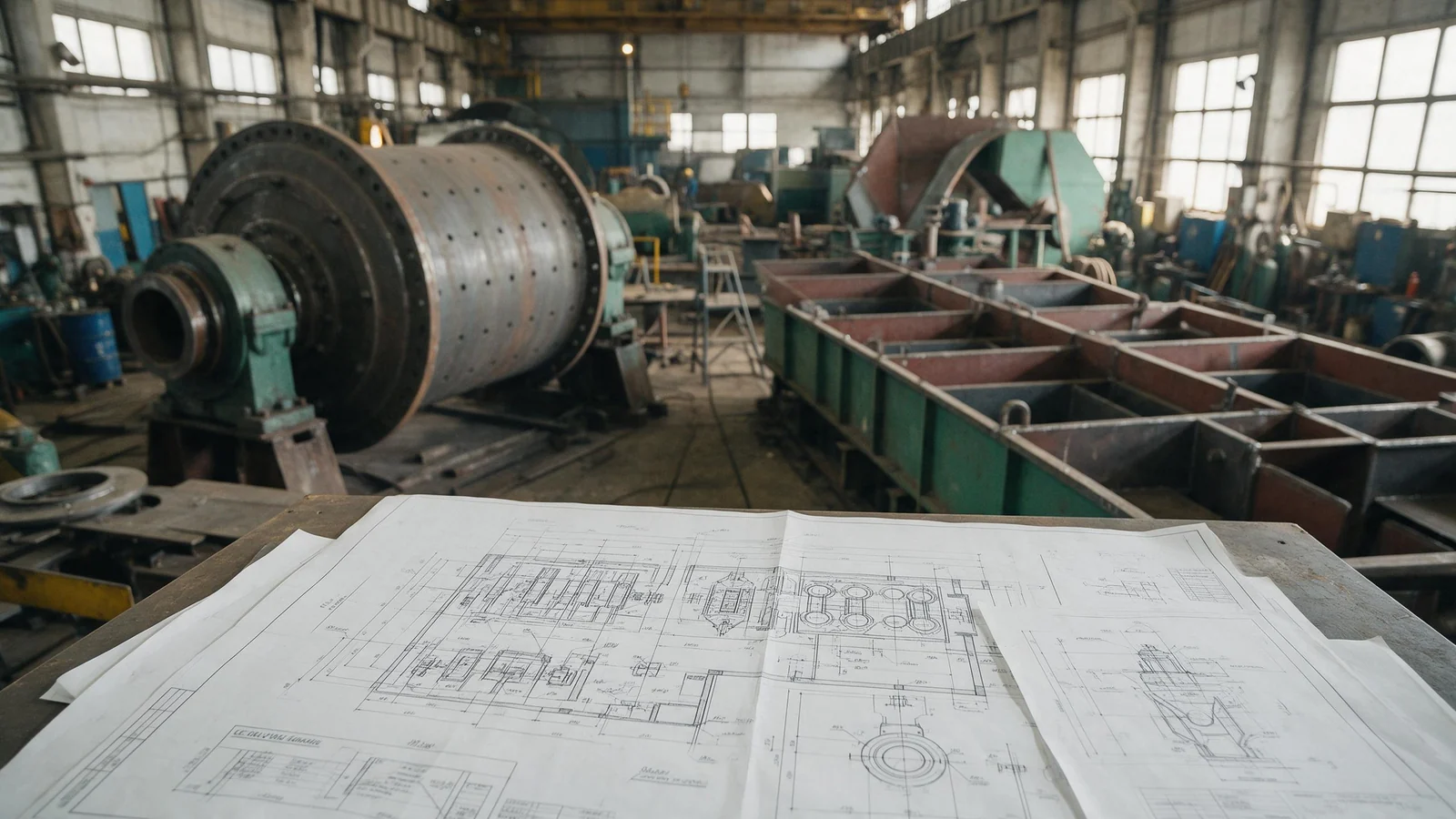
Say a mine owner asks, 'Can mineral processing plant design and manufacturing really sit under one contract without turning into a blame-shifting exercise?' It can, if the flowsheet, the shop drawings and the installation logic come from the same engineering team. That's not how every consultant works. A pure design house signs off drawings, but someone else builds the machines. Split responsibility is where schedule and quality leak.
For a small or medium mine, one contract changes the conversation. You hand over the ore characterisation, the target throughput and the site data. The same company then owns the testwork, the design, the fabrication, the shipping and the commissioning. No hand-offs between three vendors. That's the point.
Ores and grades this plant suits
This page covers copper, silver, lead-zinc and polymetallic ores in roughly the 200 to 1,500 t/d band. That includes sulphide, oxide and mixed ores. The mineralogy decides the route. Not the owner's preference. Not the equipment catalogue. A copper feed at Cu 0.80% behaves very differently from one at Cu 4.08%. Xinhai reports a 1,500 t/d Pakistan copper project with feed grade Cu 0.80%, concentrate grade Cu 20.78% and recovery 90.05%. Published project data from the same source include a 1,000 t/d Nigerian copper-silver ore at Ag 645.72 g/t and copper feeds from Cu 0.80% to Cu 4.08%.
Copper remains a substantial base metal; in 2023 the recoverable copper content of U.S. mine production was an estimated 1.1 million tons, according to the U.S. Geological Survey. That industrial weight means small and medium deposits still justify a purpose-built plant if the orebody is real.
Who does this suit? Single-asset juniors who need a plant but not a corporate engineering department. Private owners who want one throat to choke. Brownfield expansions where the existing mill is too old or too small. If you're trying to keep a 300 t/d operation alive with second-hand kit, this isn't your page. If you're planning a 1,000 t/d flotation line and want the drawings, the tanks and the motors to match, it is.
Capacity range
500 to 1,500 t/d is the practical design-and-manufacture band for this page. It's large enough to justify real testwork and a proper flotation circuit. Small enough to fit on a compact site and to ship as modules. Modular size steps of 300, 500, 700, 1,000 and 1,500 t/d are typical industry options. The company's published copper and silver cases sit at 200, 500, 1,000, 1,100 and 1,500 t/d. If you're shortlisting suppliers, this comparison of mineral processing companies shows the questions to ask.
Larger capability exists. Xinhai reports equipment supply capability for projects up to 50,000 t/d, but that's a different conversation about long-lead civil works and multiple grinding lines. This page deliberately stays within small and medium plants. That keeps the number of variables manageable.
Typical flowsheet
Most 500 to 1,500 t/d flotation plants follow a similar spine: two-stage crushing, closed-circuit grinding, classification, flotation, concentrate dewatering and tailings handling. Jaw and gyratory crushers are usually used for initial reduction in hard rock processing, as the U.S. EPA crushed stone process description notes. The flotation circuit itself may be one roughing-two scavenging-two cleaning for simpler sulphides, or one roughing-three scavenging-four cleaning for more complex polymetallic feeds. That's an operating decision, not a default setting.
Gravity separation earns a place when there is free gold or coarse silver that flotation loses. Leaching earns a place when the copper is acid-soluble and the owner wants cathode rather than concentrate. The decision belongs to testwork. This flowsheet guide walks through the selection logic and the reasons behind each unit operation.
| Ore type | Preferred route | Typical product goal | Key testwork |
|---|---|---|---|
| Sulphide copper or lead-zinc | Flotation | Smelter concentrate | Mineralogy, liberation size, rougher-cleaner kinetics |
| Oxide or mixed copper | Leaching, sometimes with SX-EW | LME-grade cathode or pregnant leach solution | Bottle roll or column leach, acid consumption |
| Oxide plus sulphide zones | Combined route, split by orebody | Concentrate plus cathode, or separate campaigns | Phase-by-phase response, per zone |
Gravity or leaching isn't a fallback: it's an alternative that either improves recovery or changes the product. The table above is a starting point, not a substitute for a locked testwork programme.
What Xinhai delivers
The scope is EPC+M+O: Engineering, Procurement, Construction, Mine Construction Management and Mine Operation Management. Under one contract you get design, equipment manufacture, procurement, packaging and transport, installation and commissioning. You can also add operation management as an option.
Xinhai's design institute carries a Class B metallurgical industry qualification. Xinhai reports that its CNAS-accredited laboratory runs about 5,000 element analyses a month plus Bond work index testing. Xinhai's fabrication shops build ball mills up to 7 m diameter, flotation cells of 320 m³, thickeners of 100 m diameter, XHCV hydrocyclones from 50 to 800 m³/h and XPAII slurry pumps. That's not a kit of parts; it's a coordinated range designed to fit the flowsheet.
For verification, ask any supplier for published project data by ore and size, not a client list you can't check. Ask for testwork reports on an ore similar to yours. Ask whether plant visits or owner calls can be arranged, though that depends on client consent and current operations. This is how a serious engineering contractor answers.
Schedule
For a 500 to 1,500 t/d flotation plant, the phase-by-phase schedule typically runs like this: design 2 to 4 months, manufacturing and procurement 4 to 7 months, sea freight and customs 1 to 2 months, civil and installation 5 to 8 months, commissioning 1 to 2 months. The total lands between 12 and 18 months on a normal greenfield site.
Brownfield with power and civils already in place can run 10 to 14 months. A remote greenfield with no road or power line can stretch to 18 to 24 months. These are typical industry ranges, not promises. The same phase logic, including cold and hot commissioning, is laid out in this commissioning note.
One published example: a lithium spodumene project reached production in approximately 12 months from testwork. That's a source of confidence only if the ore, the site and the logistics are comparable to yours. Don't transplant a schedule from one continent to another.
What we need from you to quote
You can't get a meaningful design-and-manufacturing quote from a one-line email. The supplier needs representative samples by orebody zone, enough for laboratory or pilot testwork. Full multi-element assays, mineralogy, oxidation ratio, liberation size, clay content, work index and abrasion index all matter. A Bond work index estimate is not enough; the actual test matters when grinding power dominates.
Add existing test reports, resource and mine life, target throughput, site location, power, water, access and climate. State the product plan clearly: concentrate or cathode? Environmental and tailings requirements also shape the flowsheet and the layout. The more of this you send, the closer the first engineering answer gets to a fixed scope.
Send ore data through the inquiry form below. It'll reach the right people.
Frequently asked questions
How long does it take to design and build a 500 to 1,500 t/d mineral processing plant?
Typically 12 to 18 months on a greenfield site. Design takes 2 to 4 months, manufacturing and procurement 4 to 7 months, sea freight and customs 1 to 2 months, civil and installation 5 to 8 months, and commissioning 1 to 2 months. Brownfield with power ready can be 10 to 14 months; remote greenfield can stretch to 18 to 24 months. These are typical industry ranges, not promises.
What information do I need to provide to get a plant design and manufacturing quote?
Representative samples by orebody zone, enough for laboratory or pilot testwork. Full multi-element assays, mineralogy, oxidation ratio, liberation size, clay content, work index and abrasion index. Existing test reports, resource and mine life, target throughput, site location, power, water, access and climate. Product plan, concentrate or cathode, plus environmental and tailings requirements.
How do I verify a mineral processing plant supplier's references before signing?
Ask for published project data by ore and size, not a confidential client list. Request testwork reports on an ore similar to yours. Ask if plant visits or owner calls can be arranged, subject to client consent. Check that the design institute and manufacturing base sit under the same management, and review the company's qualifications, laboratory accreditation and equipment range.
What is the difference between EPC and EPCM for a mineral processing plant?
EPC means one contractor carries engineering, procurement and construction risk, and hands over a working plant. EPCM means the contractor manages engineering, procurement and construction on the owner's behalf, but purchase orders and construction contracts stay with the owner, so the owner keeps more risk. EPC gives single-point responsibility; EPCM gives more owner control but more interfaces.